Energy Storage Blog

Subscribe to our Newsletter for Article, Industry, and Company Updates

Rainworth lithium-ion battery storage fire site with containerized BESS and visible smoke
Current Event

The Rainworth Lithium-Ion Battery Storage Fire: Local Smoke and Gas Concern

A lithium battery storage fire in Rainworth highlights how BESS failures unfold in real-world conditions. This article breaks down why lithium-ion systems catch fire, why they are difficult to control, and how system design determines whether a failure escalates into a fire event.

BESS revenue stacking concept with calculator and financial documents illustrating battery energy storage system revenue optimization.
Energy Storage

BESS Revenue Stacking: A Complete Guide to Maximizing Battery Storage Returns

BESS revenue stacking generates the most value when multiple revenue streams are combined and optimized together. This guide explains how bill savings, demand response, and market participation work as a coordinated strategy to maximize returns while balancing constraints like capacity, timing, and system design.

Participating in demand response programs with battery energy storage system (BESS) installation
Energy Storage

Participating in Demand Response Programs with Battery Storage

Battery energy storage is reshaping how sites participate in demand response. Instead of curtailing operations, batteries can reduce load and respond to grid events while maintaining normal operations. It covers participation models, value stacking, system requirements, and how to evaluate site fit.

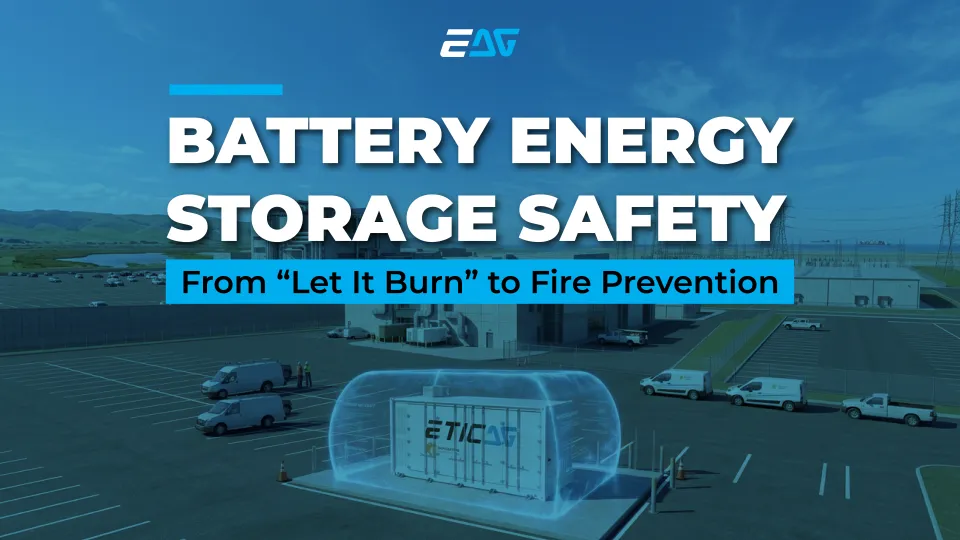
Battery energy storage facility with EticaAG container protected by a transparent safety dome, titled “Battery Energy Storage Safety: From ‘Let It Burn’ to Fire Prevention.”
Safety

Battery Energy Storage Safety: From “Let It Burn” to Fire Prevention

Battery storage is moving closer to communities, yet safety strategies still rely on a “let it burn” approach. That model accepts failure instead of stopping it. Prevention-first technologies like immersion cooling and gas neutralization stop thermal runaway propagation and eliminate toxic emissions, redefining what safe, community-ready BESS looks like.

UL 9540 battery energy storage system installed outside a commercial building in a parking area, featuring an EticaAG containerized unit with LiquidShield technology.
Regulations

What Is UL 9540 for Battery Energy Storage Systems?

UL 9540 certification determines whether a battery energy storage system can be safely deployed by evaluating the entire system, not just individual components. It integrates fire testing, battery safety testing, and system-level performance to assess real-world risk, compliance, and how systems behave under both normal and failure conditions.

UL 9540A thermal runaway testing for battery energy storage systems with EticaAG BESS installation
Regulations

What is UL 9540A Thermal Runaway Testing for Battery Energy Storage Systems?

UL 9540A defines how battery energy storage systems are evaluated during thermal runaway events, providing the data that drives safety, design, and permitting decisions. This guide explains how the test works, why it matters, and what the latest 2026 updates mean for modern BESS deployments.

High-density AI data center server racks supporting GPU workloads and high-C BESS power infrastructure
Applications

AI Data Center Power Systems: Why High-C Battery Storage Is Essential

AI data centers are hitting a power limit as GPU workloads create millisecond-scale load swings that traditional systems cannot handle. High-C battery storage stabilizes these environments, enabling full compute utilization, improving efficiency, and ensuring reliable operation in off-grid and hybrid architectures.

Battery storage system supporting California grid during March 29 evening peak and duck curve conditions
Current Event

How Battery Storage Is Addressing the Duck Curve: Insights from March 29

Battery storage is increasingly supporting the grid during peak demand. On March 29, CAISO data showed batteries delivering over 12 GW during the evening ramp, offering a real-world example of how storage is being used to manage the duck curve and improve grid flexibility.