

Key Highlights
- BESS for EV charging helps sites add charging capacity when grid service is constrained, expensive to upgrade, or slow to expand.
- Battery storage can reduce demand charges, defer some utility upgrades, improve charger availability, and support solar integration.
- Successful EV charging projects depend on proper sizing, realistic operating assumptions, and long-term lifecycle planning.
- Safety architecture affects permitting, siting, and deployment because EV charging batteries are often installed near vehicles, buildings, employees, and the public.
Why EV Charging Sites Need BESS
DC fast chargers create concentrated power demand. A site with several high-power chargers can place a large load on the utility connection in short bursts, especially when multiple vehicles charge at the same time. That peak power requirement often becomes the constraint.
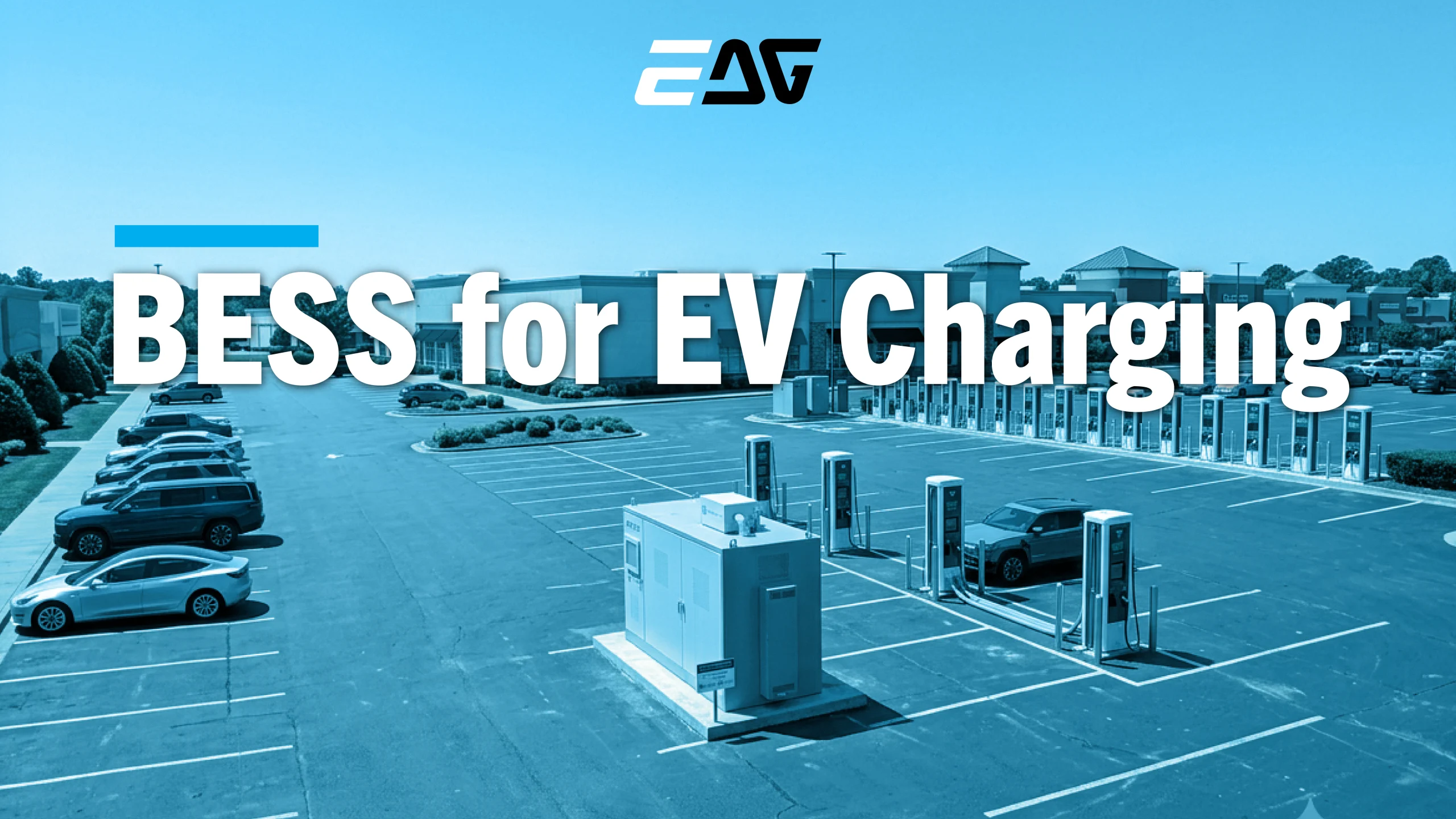
For charge point operators, fleet depots, municipalities, and commercial property owners, Battery Energy Storage Systems (BESS) offer a practical way to support higher charging demand without immediately rebuilding the utility connection. The battery charges over time, then discharges during high-demand charging periods to reduce peak grid draw and support charger availability.
This matters because charger hardware can often be installed faster than the utility can deliver new capacity. Transformer upgrades, service expansions, interconnection work, and distribution planning can stretch project timelines. Those delays can slow revenue for public fast-charging developers and delay electrification plans for fleets.
The system still has to be matched to the site. A poorly sized BESS can deplete quickly, miss demand-charge savings, and reduce long-term performance. The strongest projects evaluate charger demand, grid limits, tariffs, controls, lifecycle performance, and safety requirements before equipment is selected.
How Battery-Buffered EV Charging Works
Battery-buffered EV charging places a stationary battery system between the grid and the charging load. The battery charges when site demand is lower, electricity is cheaper, or solar generation is available. It discharges when chargers need more power than the grid connection can economically or physically provide.
Core System Components
A BESS for EV charging typically includes:
- Battery modules
- Power conversion equipment
- Battery controls
- Energy management software
- Switchgear and electrical protection equipment
- Thermal management systems
- Sensors and monitoring equipment
- Site-level safety and protection systems
Together, these components determine how much power the site can store, how quickly it can discharge, and how safely it can respond to charging demand.
The power conversion system (PCS) manages power flow between the battery, grid, and charging infrastructure. The battery management system (BMS) monitors voltage, current, temperature, state of charge, and state of health to support safe operation and long-term battery performance.
The energy management system (EMS) decides when the battery charges, when it discharges, and how the site responds to utility tariffs, charger demand, solar output, and grid limits. Controls are essential, but they cannot make an undersized battery deliver unlimited energy or replace thermal management, electrical protection, and failure-mode design.
Grid, Solar, and Storage Integration
The simplest configuration uses the grid to recharge the BESS over time. When several vehicles charge at once, the BESS discharges to support the chargers.
Solar can improve the economics when generation aligns with charging demand or when storage shifts solar energy into later charging windows. In that case, BESS increases solar self-consumption and reduces reliance on grid energy during higher-cost periods.
The key is energy balance. Storage buffers power, but it does not create energy. If a site’s average daily charging demand exceeds what the grid, solar, or another source can replenish, the battery will eventually deplete.
How BESS Solves Grid, Cost, and Uptime Challenges
The business case for EV charging BESS often comes from multiple benefits working together. A single project may combine avoided grid upgrades, demand-charge reduction, time-of-use optimization, short-duration backup, solar integration, and improved charger availability.
The value depends on site-specific factors such as utility tariffs, charger utilization, grid capacity, storage size, controls, incentives, and upgrade costs.

Avoiding or Deferring Grid Upgrades
BESS can reduce the grid service capacity required to support a charging site. Properly sized systems supply short bursts of charging demand without requiring the utility connection to deliver the full peak load.
This is especially valuable where utility upgrades are costly or slow. In some cases, battery storage allows a site to begin operating sooner while larger infrastructure upgrades are planned.
BESS can reduce peak grid demand, but it cannot replace the need for sufficient daily energy supply. If the site cannot replenish the battery, utility upgrades or additional generation may still be required.
Reducing Peak Demand and Demand Charges
Demand charges can be a major operating expense for EV charging sites. BESS reduces demand-charge exposure by discharging during peak charging periods, lowering the site’s measured grid demand.
Savings vary by utility tariff, charger utilization, battery size, and dispatch strategy. Sites with high demand charges and uneven load profiles often see the strongest economic benefit.
Improving Charging Availability
Charging availability directly affects revenue and user confidence. BESS can support charger performance during grid constraints, site load spikes, or power-quality issues that might otherwise limit charging output.
Backup duration depends on battery capacity, state of charge, charger load, and other site demands, so resilience should be evaluated against specific operating scenarios.
Supporting Solar and Load Shifting
Solar-plus-storage allows EV charging sites to store excess solar generation and use it later when charging demand increases. BESS can also support time-of-use optimization by charging during lower-cost periods and discharging when electricity prices are higher.
The economics depend on electricity price spreads, system efficiency, cycling costs, and battery degradation, making storage most effective as part of a broader site strategy.
Best Use Cases for EV Charging BESS
BESS is most valuable where charging demand is high, grid capacity is limited, utility upgrades are costly, or uptime has clear financial consequences. Common applications include:
- Public fast-charging hubs: High peak-power requirements and unpredictable demand make battery buffering valuable when grid capacity is constrained.
- Fleet depots and bus yards: BESS reduces peak load, smooths charging schedules, and supports vehicle readiness during defined charging windows.
- Commercial and retail properties: Shopping centers, office campuses, hotels, and mixed-use developments can add charging capacity without major electrical service upgrades.
- Parking facilities and garages: Because charging infrastructure is located near vehicles, occupants, and building systems, thermal management and off-gas handling become important siting considerations.
- Weak-grid or remote locations: Storage buffers charging demand where grid capacity is limited, provided the battery can be replenished reliably.
- Solar-plus-charging sites: BESS stores excess solar energy, reduces demand peaks, and shifts energy into higher-value charging periods.
BESS Sizing, Controls, and Lifecycle Economics
Sizing is where EV charging BESS projects often succeed or fail. The system must be large enough to support charging demand, but not so large that capital costs outweigh the value it creates.
First-Hour and Design-Day Sizing
Sizing starts with two questions:
- Can the system support the site’s peak charging demand during the first hour of operation?
- Can the site replenish enough energy to meet demand across a representative high-use day?
The first question focuses on power and energy capacity during peak charging periods. If multiple chargers operate simultaneously, the battery must be able to support that load without quickly depleting.
The second focuses on energy balance. The site must have enough energy input from the grid, solar, or another source to replenish the battery and meet daily charging demand.
If the answer to either question is no, charger performance, customer experience, and project economics can suffer.
Key Inputs for BESS Sizing
BESS sizing depends on charger count, charger power, expected utilization, dwell time, site load, available grid capacity, utility tariffs, solar production, and resilience requirements.
The model should also account for controls. Two sites with identical batteries can perform very differently depending on dispatch logic, charger coordination, and tariff optimization.
Battery Degradation and Financial-Model Fidelity
Battery cycling gradually reduces capacity, making degradation an important consideration in any financial model. Thermal management also affects battery life, as elevated temperatures and uneven cell conditions can accelerate aging.
Round-trip efficiency losses further influence project economics because stored energy does not return at 100% efficiency. A credible BESS analysis should account for degradation, efficiency losses, and operating conditions over the system’s lifetime, not just on day one.
Safety, Permitting, and Siting Risk for EV Charging BESS
Safety is a commercial requirement for EV charging BESS. High-power charging sites are often located near vehicles, buildings, employees, fleet assets, and public infrastructure, making risk management a critical part of project planning.
Thermal Runaway and Hazardous Off-Gases
Lithium-ion battery failures can involve thermal runaway, propagation, heat release, and hazardous off-gases. These gases may contain flammable and toxic compounds, making gas management an important safety consideration.
For EV charging projects, the risk extends beyond the battery enclosure. A failure event can affect nearby vehicles, building systems, emergency response, and public confidence. Standards such as UL 9540 and UL 9540A, along with local fire code requirements, often play a role in permitting and project review.
Why Safety Architecture Affects Deployment
Dense charging sites face greater scrutiny because batteries are frequently installed near people and valuable assets. As a result, safety considerations can influence site layout, separation distances, emergency response planning, permitting, and insurance review.
Many conventional lithium-ion systems rely on detection and suppression after abnormal conditions begin. A stronger approach focuses on preventing ignition, reducing thermal propagation risk, maintaining stable cell temperatures, and controlling hazardous off-gases if a cell failure occurs.
EticaAG’s Prevention-Based Approach
For EV charging sites where safety and siting matter, the BESS architecture should prevent fire before it starts. EticaAG’s LiquidShield™ immersion cooling keeps battery cells submerged in a high fire-point dielectric fluid. The system maintains uniform cell temperatures, prevents hot spots, and reduces battery degradation.
LiquidShield™ also changes the fire-risk profile at the cell level. By surrounding each cell with dielectric fluid, it suppresses ignition and limits thermal propagation pathways that conventional air-cooled and cold-plate systems must manage reactively.
Hazardous off-gas management is the second layer. HazGuard contains, routes, and neutralizes hazardous off-gases within a sealed module before safely exhausting neutralized byproducts. This supports emergency response planning, siting confidence, and public acceptance.
What to Look for in an EV Charging BESS
The best EV charging BESS is designed around the site’s grid capacity, charging demand, utilization profile, and energy requirements. Accurate sizing is critical to performance, economics, and long-term reliability.
Safety is equally important. Review thermal management, off-gas handling, testing documentation, and permitting support before selecting a system.
The best projects evaluate performance, economics, and safety together rather than treating them as separate decisions.
BESS for EV Charging Quiz
Test your understanding of how battery energy storage supports fast-charging sites by reducing grid constraints, demand charges, uptime risk, and safety challenges.
Frequently Asked Questions
What is BESS for EV charging?
BESS for EV charging is a battery energy storage system that supports EV chargers by storing energy and discharging it during high-power charging demand. It reduces peak grid draw, supports more charging capacity behind limited grid service, and can improve site economics. A complete system includes batteries, power conversion, controls, thermal management, and safety systems.
How does battery storage help EV charging stations?
Battery storage helps EV charging stations by buffering power between the grid and chargers. The battery charges over time, then discharges when vehicles need high-power charging. This can reduce grid upgrade requirements, lower demand charges, improve charging availability, and support solar or time-of-use energy strategies.
Can BESS reduce demand charges for EV charging?
Yes, BESS can reduce demand charges by discharging during peak charging periods and lowering the site’s measured grid demand. The savings depend on the utility tariff, charger utilization, battery size, and EMS dispatch strategy. Sites with high demand charges and uneven charging peaks often have stronger savings potential.
Can battery storage help avoid EV charging grid upgrades?
Battery storage can help avoid or defer EV charging grid upgrades when the existing grid connection can supply enough average daily energy. The BESS reduces instantaneous power demand by serving part of the charger load during peaks. If the site’s average energy demand exceeds available grid supply, storage alone will not solve the constraint.
How is BESS sized for EV charging sites?
BESS is sized around charger count, charger power, expected utilization, dwell time, available grid capacity, tariff structure, solar output, and resiliency requirements. Good sizing also considers first-hour peak demand and design-day energy balance. Undersized storage can deplete quickly and reduce charger output.
Is BESS safe for EV charging stations?
BESS can be safe for EV charging stations when the system uses strong thermal management, electrical protection, safety controls, fire-prevention architecture, and credible documentation. Safety matters more in dense locations such as parking facilities, fleet depots, commercial sites, and public charging hubs. Buyers should evaluate thermal runaway prevention, off-gas handling, testing, and permitting readiness.


