

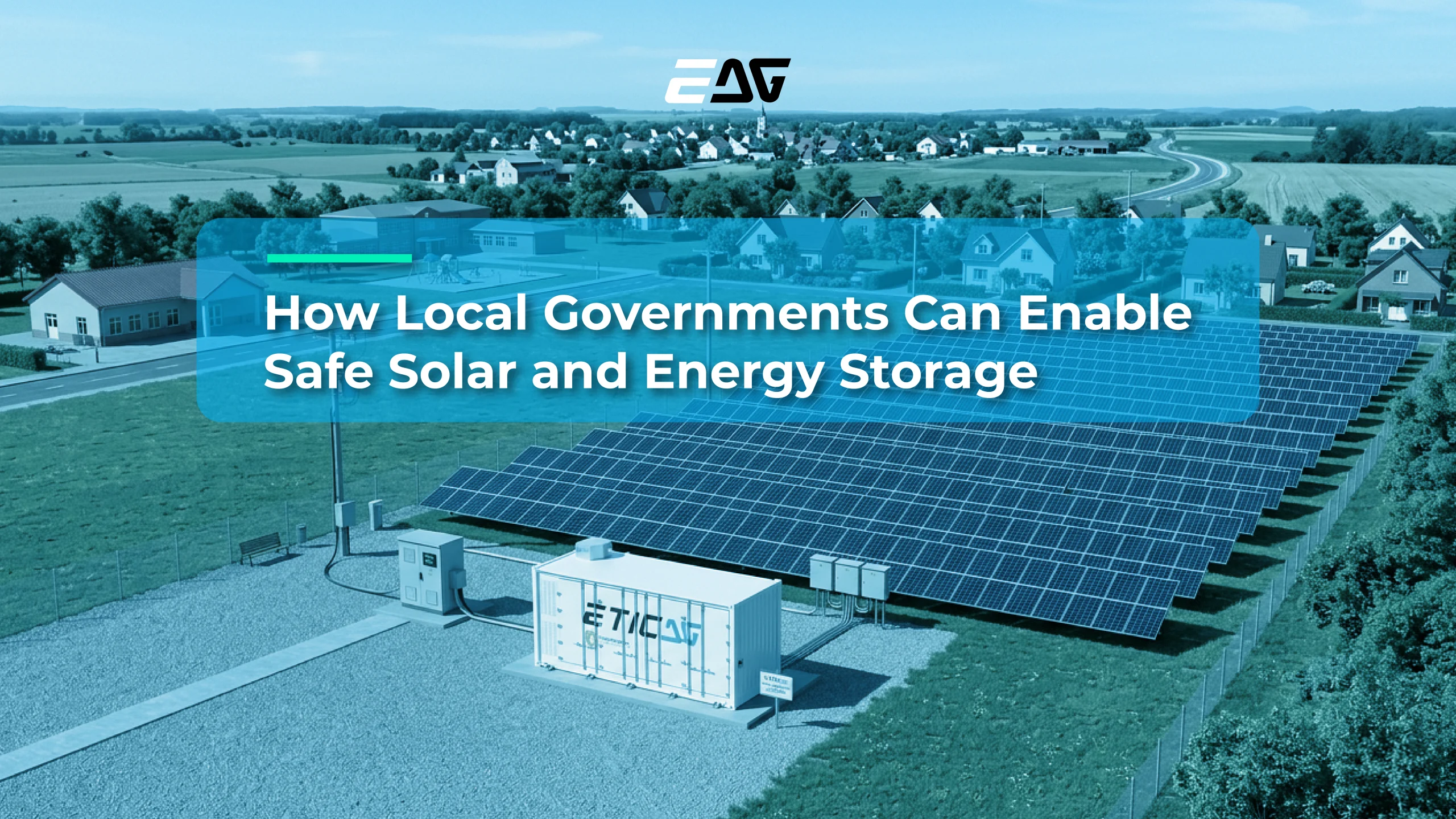
Solar and battery storage projects often fail at the local level even after the economics already work. Local governments can enable safe solar and energy storage by replacing broad Battery Energy Storage System (BESS) bans with clear zoning, predictable permitting, and safety standards that approve safe systems quickly while rejecting unsafe systems clearly.
Cities and counties need resilience, lower energy costs, and a grid prepared for electrification. They also need to protect residents, businesses, and first responders from fire propagation, toxic gas release, poor siting, and unclear emergency response plans.
The answer is to define what safe deployment requires, publish the rules, and create faster pathways for projects that meet those standards.
Local Governments Should Require Better BESS, Not Ban BESS
Battery energy storage systems support solar deployment, peak demand reduction, backup power, and grid resilience. With storage, communities can shift solar energy into evening demand, support critical facilities, and reduce strain on the grid during high-load periods.
Local concern about BESS safety is justified. Conventional lithium-ion systems can raise serious questions about thermal runaway, fire propagation, toxic off-gassing, emergency access, water use, and long-duration response events. Those questions deserve direct answers.
Broad bans and open-ended moratoriums do not provide those answers. They delay projects without defining the safety threshold a better project must meet. A stronger local policy permits safe systems quickly, rejects unsafe systems clearly, and avoids blanket restrictions that block responsible deployment.
Why Solar + Storage Projects Stall at the Local Level
Many solar + storage projects stall because the local pathway is unclear.
Permitting delays are one of the most common friction points. When applicants do not know which department leads review, which forms are required, or how long approval will take, projects absorb additional soft costs. Developers may need to redesign systems, revise site plans, or wait for sequential reviews from planning, building, electrical, and fire officials.
Zoning ambiguity creates another barrier. If the local code does not define BESS as a use, staff may need to decide whether storage fits under utility infrastructure, accessory equipment, industrial use, or another category. That uncertainty can trigger discretionary review even for projects that could be safely handled through an administrative pathway.
Community opposition often grows in that vacuum. Residents hear “battery storage” and think of major fire events, toxic gases, or a “let it burn” emergency response strategy. If the city has no clear ordinance, those concerns can push officials toward a pause.
Incentives cannot fix that problem. A rebate may improve project economics, but it does not solve unclear zoning, unpredictable review timelines, or undefined safety requirements. For municipalities, certainty is often the most valuable incentive.
The Best Local Incentive is Permitting Certainty
Local governments do not need large budgets to make solar + storage easier to build. They can start by making the process predictable.
A strong permitting framework should include a unified application, published review timelines, clear submittal requirements, coordinated fire review, and a single point of contact for applicants.
For larger commercial and industrial systems, a complete application should move through review within a published timeline, such as 30 to 45 days. Applicants should know what evidence is required. Fire officials should see the emergency response plan early, not at the end of review.
Certainty reduces soft costs, improves project financeability, and protects municipal staff from one-off negotiations because the rules are already public.
What a Safe BESS Ordinance Should Require
A local BESS ordinance should separate projects by size, location, and use case. A small residential battery does not need the same review pathway as a multi-megawatt system near occupied buildings. A commercial system in an industrial district should not face the same land-use process as a utility-scale installation in sensitive areas.
Tiered zoning gives cities and counties a practical structure. Residential and small commercial systems can receive streamlined review when they meet published standards. Larger commercial systems can move through administrative or site plan review in commercial and industrial zones. Utility-scale systems can require full siting review, public notice, emergency response documentation, and decommissioning plans.
Require No Fire Propagation
For urban, rooftop, indoor, commercial, or population-adjacent locations, applicants should demonstrate that the BESS is designed to prevent thermal runaway from spreading beyond the point of failure. A single-cell or module-level event should remain isolated and should not escalate into a cabinet-, building-, or site-level fire.
Municipalities should ask applicants to describe the technologies and chemistries that support this outcome. Examples include:
- Immersion cooling systems that submerge lithium-ion cells in dielectric fluid to maintain uniform temperatures, isolate cells from oxygen, prevent ignition, and stop fire propagation at the cell level.
- Non-propagating pack and module designs that use spacing, barriers, insulation, venting paths, and controlled failure zones to prevent heat transfer between cells or modules.
- Fire-safe chemistries, such as sodium-ion, flow batteries, zinc-based batteries, or other chemistries with reduced thermal runaway and fire-propagation risk.
Require No Uncontrolled Toxic Gas Release
Local ordinances should also require a gas management plan. That plan should explain how hazardous off-gases are contained, neutralized, ventilated, or otherwise prevented from uncontrolled release into occupied spaces, neighboring properties, or the surrounding community.
BESS systems designed with sealed gas handling and toxic gas neutralization can address concerns that conventional systems often leave unresolved.
Reject “Let it Burn” Emergency Planning
A safe approval pathway should require more than a generic fire response document. Emergency plans should be based on isolation, shutdown, and controlled procedures. Fire departments need site-specific information, access plans, disconnect locations, training expectations, and communication protocols.
A “let it burn” posture is a poor fit for urban, rooftop, indoor, and population-adjacent sites. Cities and counties should make that clear in ordinance language.
Systems engineered for thermal management and ignition prevention give AHJs a clearer basis for approval.
How EticaAG Supports Safe BESS Installations
For local governments, safer permitting depends on evidence. EticaAG designs BESS architecture around the same safety questions AHJs need answered:
- Can a cell failure propagate?
- Can hazardous off-gases escape uncontrolled?
- Can first responders rely on a defined response plan?
LiquidShield™ Prevents Thermal Propagation
LiquidShield™ immersion cooling submerges every cell in dielectric, high fire-point fluid. The fluid transfers heat away from the cells, maintains uniform temperatures, and prevents hot spots that contribute to thermal runaway risk.
In the event of an internal cell failure, the liquid barrier isolates cells from oxygen, suppresses ignition, and stops fire propagation at the cell level.
HazGuard Neutralizes Toxic Gas
HazGuard contains and routes hazardous off-gases within a sealed module, converting flammable and toxic gases into inert byproducts before exhaust.
Together, LiquidShield™ and HazGuard give municipalities a concrete safety framework to approve systems that demonstrate thermal management, ignition prevention, controlled gas management, and clear emergency response.
A Practical Action Plan for Cities and Counties
Local governments can enable safer solar + storage deployment with a practical sequence.
Adopt a Tiered BESS Zoning Ordinance
Cities and counties should define BESS project categories by size, use, and location. Small residential and commercial systems should have streamlined pathways when they meet published requirements. Larger commercial or population-adjacent systems should receive more detailed review, especially when they are located near occupied buildings, critical facilities, or dense neighborhoods.
A tiered ordinance prevents municipalities from treating every system as the same risk.
Publish a Solar + Storage Checklist
Applicants should not need to guess which department owns which requirement. A unified checklist should cover zoning, electrical, building, fire, emergency response, interconnection coordination, and decommissioning.
This is one of the lowest-cost reforms a local government can make. It reduces incomplete applications, limits back-and-forth between departments, and identifies which documents are required for different project types, such as site plans, equipment specifications, emergency response plans, gas management plans, and decommissioning plans.
Set Review Timelines for Larger Projects
For commercial, industrial, and larger community-scale projects, municipalities should publish review timelines. A 30- to 45-day target for complete applications gives developers and city staff a shared expectation.
The key word is “complete.” Cities should define what a complete application includes, then commit to a predictable review window once those materials are submitted. That structure protects staff from rushed or incomplete filings while giving developers the certainty needed to finance and schedule projects.
Create an Incentive Navigation Webpage
Local governments do not need to fund every project directly. They can still make projects easier by helping residents, businesses, and public agencies find the incentives and financing that already exist.
A local webpage should include federal tax credit information, direct pay guidance for public entities, state programs, utility contacts, C-PACER financing, and any local fee waivers or rebates.
Demonstrate Safe Deployment on Public Facilities
Cities and counties should consider solar + storage projects at fire stations, emergency operations centers, community centers, libraries, and senior centers. These facilities connect storage to resilience, public service, and emergency preparedness.
Public projects also build trust. Residents are more likely to support safe deployment when they can see a well-designed system operating at a familiar public site. These projects give local officials, fire departments, and facility managers practical experience with the same technologies they may later review in private applications.
Coordinate Early with Fire Officials and Utilities
Safe deployment depends on more than zoning approval. Local fire officials should be involved early enough to review access, shutdown procedures, gas management, and emergency response plans before a project reaches final approval. Utilities should also be part of the process because interconnection timelines can affect project feasibility.
A city that coordinates planning, fire, building, electrical, and utility review gives applicants a more predictable path and gives the community a stronger safety process.
Permit Better BESS Policy Brief (Download)
EticaAG’s policy brief gives local governments a practical framework for approving safer BESS projects quickly while rejecting unsafe systems clearly. It outlines standards for high-consequence locations, including no fire propagation, no uncontrolled hazardous gas release, no let-it-burn containment strategy, and a predictable 30–45 day review timeline.

Clear Rules Can Unlock Safer Solar and Storage Deployment
Local governments have more influence over solar + storage deployment than many realize. Federal incentives, state programs, and private capital may make projects viable, but local rules determine whether they get built.
The strongest path is neither broad approval nor broad prohibition. Cities and counties should define what safe BESS requires, publish predictable approval pathways, and move qualified projects forward with confidence.
For municipalities evaluating battery storage standards, EticaAG’s safety technology resources show how immersion-based thermal management, ignition prevention, and toxic gas neutralization directly address the core concerns behind many BESS moratoriums.
Solar & BESS Permitting Quiz
Test your understanding of tiered zoning, safety ordinances, and the permitting steps that help communities enable energy storage projects.
Local BESS Enablement Frequently Asked Questions
What can local governments do to enable solar and energy storage?
Local governments can enable solar and energy storage by creating clear zoning, predictable permitting, and safety-based approval standards. The strongest steps are tiered BESS ordinances, unified permit checklists, review timelines, incentive navigation, and public demonstration projects.
Should cities ban battery energy storage systems?
Cities should not use broad BESS bans as a substitute for safety standards. A better approach is to permit systems that meet clear fire, gas management, siting, emergency response, and decommissioning requirements while rejecting systems that cannot meet those standards.
What should a local BESS ordinance include?
A local BESS ordinance should define system types, tier projects by size and location, identify allowed zoning districts, require applicable safety standards, and establish emergency response and decommissioning requirements. It should also clarify which projects qualify for streamlined, administrative, or special review.
How can zoning rules make battery storage safer?
Zoning rules make battery storage safer by matching review intensity to project risk. They can define setbacks, allowed districts, screening, noise limits, emergency access, public notice, and special requirements for rooftop, indoor, urban, or population-adjacent sites.
How can local governments reduce solar + storage soft costs?
Local governments can reduce soft costs by publishing requirements, coordinating department review, setting clear timelines, and automating standard permits. These steps reduce redesign cycles, administrative delays, and financing uncertainty.
What safety standards should BESS projects meet?
BESS projects should meet applicable codes and standards such as NFPA 855 and UL 9540. UL 9540A data can help reviewers understand thermal runaway and propagation behavior, but AHJs should require project-specific evidence that the system prevents fire propagation, controls hazardous off-gases, and has defined emergency response procedures.
How can cities support BESS without using local subsidies?
Cities can support BESS without local subsidies by improving permitting, clarifying zoning, routing property owners to C-PACER financing, publishing incentive guidance, and using public facilities for demonstration projects. These actions reduce friction without requiring large local expenditures.


