

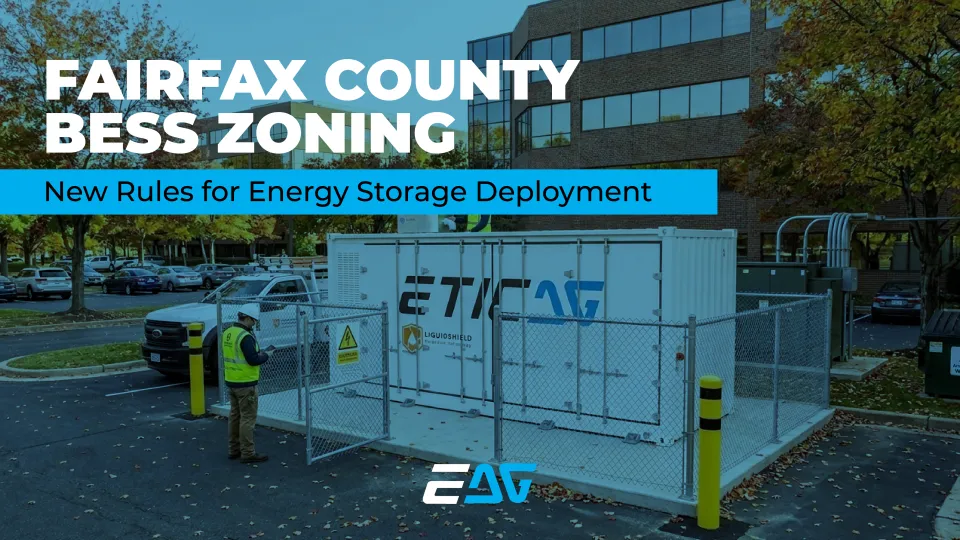
Battery energy storage is expanding into dense, high-demand regions, but local zoning is determining how and where it can be built. Fairfax County’s BESS zoning now requires large-scale systems to undergo Special Exception approval, meet defined setback and noise requirements, and comply with safety standards before development.
In 2024, a proposed 20 MW battery storage project entered pre-application review in a county with no large-scale systems and no dedicated zoning rules. Rather than move forward under existing classifications, Fairfax County initiated a full zoning rewrite to establish clear requirements before projects could advance.
By March 2026, that effort resulted in a new zoning framework approved after months of technical review, public engagement, and policy development. The result is a defined path for how battery energy storage must be designed, sited, and approved in Fairfax County.
Why Fairfax County Acted Before Deployment
Fairfax County didn’t wait for a surge in battery storage projects or a triggering incident. It acted early, before large-scale systems were deployed.
At the time of the zoning rewrite, no large-scale battery energy storage systems existed in the county. A proposed 20 MW project entered pre-application review in 2024 but did not advance further. That moment introduced utility-scale storage into a densely developed region with complex land use considerations.
Rather than evaluate projects under existing utility classifications, the County chose to establish a framework first. Battery storage was elevated to a Priority 1 item in the Zoning Ordinance Work Program, signaling urgency and long-term importance.
This decision led to a structured, multi-year process that extended through 2025 and into 2026. The County conducted technical research, reviewed how other jurisdictions regulate BESS, engaged with utilities and industry stakeholders, and held community meetings to gather input.
Draft zoning language was released in 2025 and refined based on feedback. By early 2026, the proposal moved into formal hearings:
- February 25, 2026: Planning Commission voted 10-0 to recommend adoption
- March 17, 2026: Board of Supervisors held the final public hearing
The outcome reflects a deliberate policy effort to define how battery storage should be deployed before projects move forward, not after.
What the New Fairfax County BESS Zoning Framework Requires
The updated ordinance introduces a defined set of rules that determine how large-scale battery systems are classified, approved, and developed. These changes replace the previous flexibility with a structured framework.
Before this update, BESS was not clearly defined in Fairfax County zoning and was interpreted as a light utility facility, allowing by-right development in certain industrial zones. The new framework eliminates that ambiguity and establishes consistent requirements for large-scale systems.
Key requirements include:
1. Defined Threshold for Large-Scale BESS
Fairfax County now defines large-scale BESS as systems exceeding 600 kWh, creating a clear distinction between accessory systems and utility-scale infrastructure.
Systems above this threshold are subject to full zoning review and operational requirements.
2. Special Exception Approval
Most large-scale systems now require a Special Exception (SE), replacing prior by-right development in industrial districts. This introduces a formal approval process that includes public hearings, Board-level decision making, and case-by-case evaluation.
Projects must demonstrate compatibility with surrounding land uses, not just basic zoning compliance, before they can move forward.
3. Siting Restrictions
Large-scale BESS are not permitted in residential districts, except when co-located with substations or solar.
This limits where projects can be developed and prioritizes separation from residential environments, reducing the number of viable sites.
4. Setback Requirements
Projects must meet minimum distance requirements:
- 100 feet from property lines
- 200 feet from residential uses
These setbacks are tied to concerns around noise, safety, and visual impact, and they directly influence site selection, system layout, and total land required for development.
5. Noise Compliance
Developers must submit a noise study prior to site plan approval.
Battery systems can generate 80-90 dBA at the source, while Fairfax County’s Noise Ordinance sets maximum sound levels at the property boundary based on the receiving land use and time of day, with allowable limits significantly lower than those source levels.
Without sufficient attenuation through distance, barriers, or system design, projects can exceed allowable limits, making noise a critical factor in project approval.
6. Safety and Operational Requirements
Projects must comply with NFPA 855 and UL 9540A testing standards, which evaluate how battery systems perform under failure conditions, including thermal runaway and fire propagation.
In addition, developers must submit emergency operations plans and coordinate with fire response agencies to ensure preparedness before systems are operational.
7. Lifecycle and Decommissioning Requirements
Developers must submit decommissioning plans that outline how systems will be removed at the end of their operational life, along with financial assurance to guarantee full system removal and site restoration.
This ensures battery systems are treated as long-term infrastructure with defined end-of-life responsibilities, reducing risk for both the County and surrounding community.
Why These Concerns Took Center Stage
The zoning rewrite reflects a combination of technical realities and community expectations. As battery energy storage moved closer to residential and mixed-use areas, the focus shifted from general permitting to specific risks tied to how these systems operate.
Thermal Runaway
Thermal runaway became a central concern due to how battery cells behave under failure conditions. When a cell fails, it can release heat and gases rapidly. The key question for both regulators and communities is whether that event remains contained within a single cell or spreads across the system.
Noise
Battery systems operate continuously, and components such as cooling systems and inverters create a steady acoustic profile. Unlike intermittent industrial noise, this is persistent, which makes compliance with local limits more critical, especially near residential areas.
Emergency Response
Battery-related incidents require different procedures than traditional fires, including extended monitoring and specialized handling. Local fire departments must be prepared before a system becomes operational, not after.
Land Use Compatibility
Large, containerized battery units can be visually and functionally similar to industrial equipment. Setbacks, screening, and siting restrictions are intended to ensure these systems do not disrupt surrounding uses.
Together, these factors shaped the structure of the ordinance and explain why Fairfax County chose to define requirements in detail before large-scale deployment occurred.
Energy Storage Remains Essential
Even with increased regulation, the need for battery storage continues to grow.
Reliable Power
Battery systems help keep the lights on when electricity demand spikes. As more people use electric vehicles, all-electric buildings, and energy-intensive technologies, the grid is under more pressure than ever.
Energy storage helps balance that demand. It stores electricity when it’s available and releases it when it’s needed most, reducing the risk of outages, especially in busy, high-density areas like Fairfax County.
Lower Energy Costs
Electricity is most expensive during peak hours, when demand is highest.
Battery storage helps reduce that pressure by shifting energy use away from those peak times. This lowers overall system costs and helps stabilize electricity prices for both homeowners and businesses.
Protecting Critical Services
When the power goes out, some systems cannot afford to go down.
Battery storage provides backup power for critical infrastructure like hospitals, emergency services, water systems, and communication networks. This helps communities remain safe and operational during outages.
Avoiding Major Construction
Upgrading power lines and transmission systems can take years and often disrupt communities.
Battery storage can be installed closer to where electricity is used, reducing the need for large infrastructure projects. This means fewer disruptions and faster solutions for growing energy demand.
Supporting Clean Energy
Renewable energy sources like solar and wind do not always produce power when it is needed.
Battery storage helps solve that problem by storing clean energy and delivering it later. This makes renewable energy more reliable and supports long-term clean energy goals in states like Virginia.
How EticaAG Designs Systems That Address Root Causes
The requirements outlined in Fairfax County’s ordinance are directly tied to how battery systems manage heat, noise, and failure conditions. As these regulations become more defined, system architecture determines whether a project can meet zoning, safety, and performance requirements.
EticaAG’s battery energy storage systems are designed to address these challenges at the source, aligning system performance with the concerns driving local regulation.
Thermal Management and Ignition Prevention
EticaAG’s LiquidShield immersion cooling submerges each battery cell in a non-toxic dielectric fluid. This continuously transfers heat away from the cells, maintaining stable operating temperatures across the system and eliminating the conditions that lead to thermal runaway.
At the same time, immersion cooling isolates every cell from oxygen. In the event of an internal cell failure, flames cannot form. Ignition is prevented immediately, and fire propagation stops at the source.
This directly addresses one of the primary concerns reflected in Fairfax County’s safety requirements, which focus on preventing thermal events from spreading across a system.
Gas Management and Environmental Protection
Battery failure scenarios can produce toxic gases such as carbon monoxide, hydrogen fluoride, and other hazardous compounds.
EticaAG’s HazGuard toxic gas neutralization system captures these gases within a sealed environment and directs them through controlled pathways. It neutralizes hazardous compounds and safely exhausts inert air outside the enclosure.
By addressing gas formation at the source, the system reduces exposure risk and supports safer emergency response, aligning with the air quality and safety concerns that influence zoning approvals.
Alignment With Zoning and Performance Requirements
EticaAG’s integrated system architecture addresses the same factors that now define project approval, including thermal management, fire risk, noise, and environmental impact.
A key advantage is how immersion cooling changes system noise. Conventional BESS rely on HVAC systems and high-speed fans, which are the primary sources of continuous operational sound. EticaAG’s immersion-cooled systems operate without HVAC by transferring heat directly into a liquid medium surrounding each cell, eliminating the dominant mechanical noise source and reducing the need for extensive mitigation measures such as barriers, enclosures, or large setbacks.
By eliminating fire propagation, controlling heat at the source, and reducing both noise generation and environmental impact, EticaAG’s approach aligns directly with the safety, noise, and siting requirements outlined in Fairfax County’s zoning framework.
As more jurisdictions adopt similar regulations, system design will play a central role in determining which projects can move forward and how efficiently they can be approved.
Conclusion: Fairfax Defines the Next Phase of BESS Deployment
Fairfax County acted before large-scale battery storage was deployed, choosing to define the rules in advance rather than react after projects moved forward.
The result is a structured zoning framework that prioritizes safety, compatibility, and accountability. Battery storage is now treated as critical infrastructure that must meet clear standards for siting, performance, and long-term operation.
Projects in Fairfax County now depend on early-stage regulatory analysis, detailed engineering validation, and proactive engagement with stakeholders before submission. This approach is likely to influence other jurisdictions as they evaluate how to integrate energy storage into existing communities.
Battery storage will continue to expand. The systems that meet these requirements through design and performance will determine how quickly and where that expansion moves forward.


