

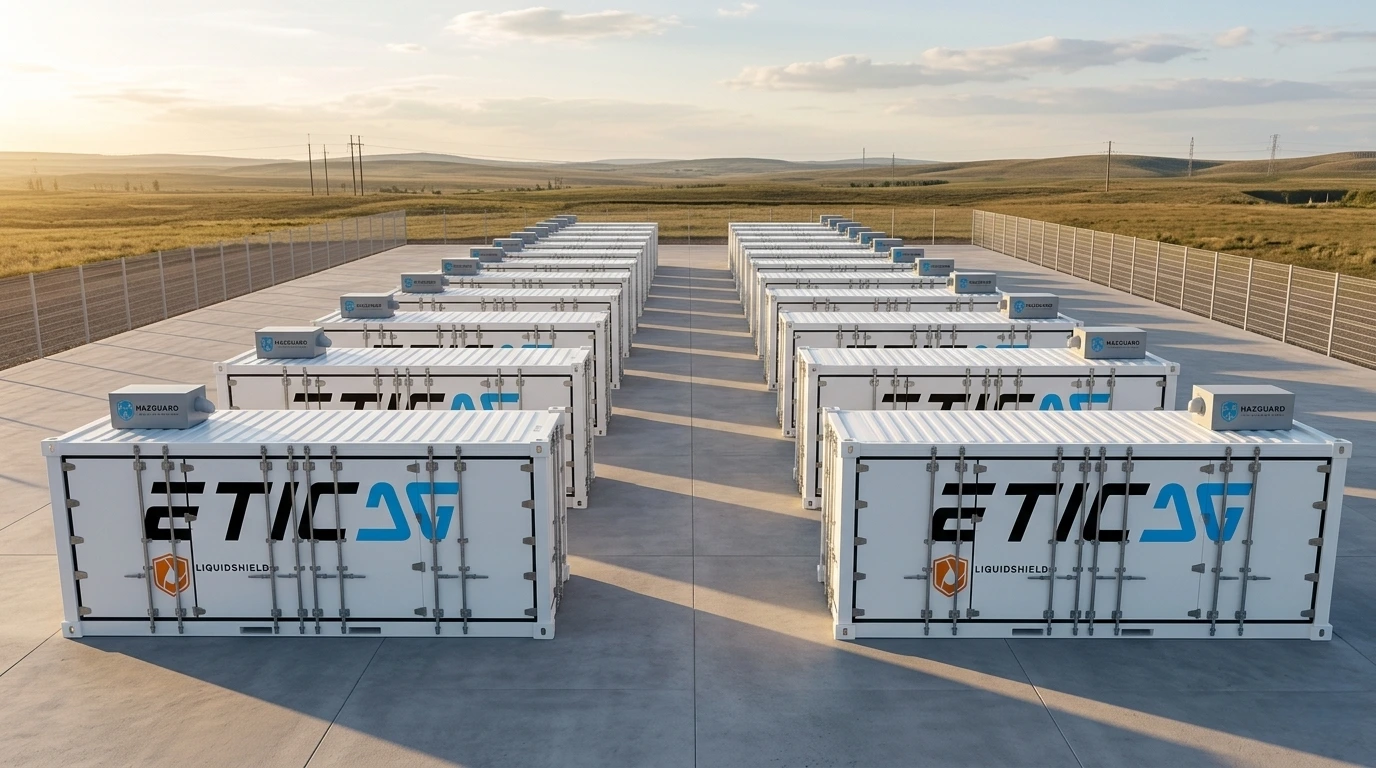
Key Highlights
- Uniform temperatures slow degradation and protect long-term project economics.
- Hot spots accelerate aging, imbalance, and premature capacity loss.
- LiquidShield™ cools every cell surface for more predictable lifecycle performance.
- Immersion cooling extends battery life 22% versus cold plate cooling
The Hidden Cost of Poor Thermal Management in BESS
Thermal management is one of the most underestimated variables in Battery Energy Storage System (BESS) performance. How a battery system is cooled determines not only how safe it is, but how long it lasts, how well it performs, and whether it delivers the returns your financial model projected.
All batteries lose capacity over time. That decline is expected and typically built into financial models. What is often underestimated is how quickly degradation accelerates when thermal management is inconsistent or ineffective.
The industry generally defines end of useful life as the point when a battery retains 60% of its original capacity. In a system with stable, uniform thermal conditions, degradation can track a predictable path toward that threshold. In a system with hot spots, uneven cell aging, or repeated temperature swings, capacity loss accelerates and useful life can end years earlier than planned.
The financial consequences are already visible in real-world deployments. A NYSERDA study on energy storage system performance found that only 4 of 10 standalone storage projects delivered the anticipated financial benefits. Thermal management was ranked as the system component most likely to fail. Average round-trip efficiency across the projects was 79%, below projections, and one project performed as low as 16%. Two of the projects required repairs every year, adding cost and reducing revenue through downtime.

Temperature Is the Root Cause of Premature Battery Degradation
High temperatures don’t just stress batteries. They actively accelerate the chemical reactions that break them down.
Every 10°C Rise Roughly Doubles the Degradation Rate
This relationship is described by the Arrhenius equation, a principle from physical chemistry that governs reaction rates as a function of temperature. Applied to lithium-ion batteries, the rule of thumb is direct. For every 10°C increase in operating temperature, the degradation rate approximately doubles, and the battery’s useful life is roughly halved.
Both LFP and NMC chemistries follow this pattern. The DNV 2024 Battery Scorecard tested cells under similar cycling conditions and found that both chemistries degraded faster at 40°C compared to a 22°C baseline, with NMC cells losing 2% or more capacity at elevated temperature. The goal for any thermal management system is to keep every cell consistently in the range where degradation stays slow and linear.

Hot Spots Cause Capacity Loss and Thermal Runaway Risk
Temperature variation across a battery pack does more than create locally stressed cells. It creates a resistance imbalance that accelerates degradation across the entire system.
When some cells run hotter than others, their internal resistance increases. In a parallel-connected pack, higher-resistance cells deflect current toward the cooler, lower-resistance cells. Those cooler cells absorb more load than they should. Over hundreds of cycles, cells age at different rates. The pack loses capacity not because every cell is worn out, but because the weakest cells are dragging down the rest.
In the worst case, this imbalance doesn’t stop at degradation. One overheated cell can generate enough heat to push neighboring cells past their thermal limits, triggering a thermal runaway that can propagate into a large-scale fire event.
The Degradation Knee: When Battery Life Falls Off a Cliff
Under stable thermal conditions, a lithium-ion battery’s capacity loss follows a gradual, predictable curve. Financial models depend on that predictability. When thermal management is inadequate, that curve breaks.
The “knee” is the point at which capacity loss stops being gradual and becomes sudden. DNV’s 2024 Scorecard captured this clearly. One NMC cell performed normally through 250 turnovers, then lost nearly 40% of its initial capacity within the next 250. Once a battery hits the knee, useful life is effectively over regardless of what the original model projected.
By the time the knee appears in performance data, the financial damage is already done.

Air and cold plate cooling can’t maintain consistent cell temperatures
The two most common thermal management approaches in deployed BESS, air cooling and liquid cold plate, share a fundamental limitation: neither can deliver consistent, uniform heat removal to every cell in the system.
Air cooling works reasonably well at low discharge rates, but it loses effectiveness as charge and discharge rates increase. Higher loads generate more heat, faster, and air can’t remove it quickly enough to prevent temperature buildup. Air cooling also consumes significantly more parasitic power than liquid alternatives, a cost that compounds over the system’s lifetime.
Liquid cold plate systems improve on air cooling by circulating coolant through plates attached to the battery modules, but the cooling is still limited to a single surface. Heat generated deeper within the cells, especially in areas farther from the plate, can accumulate faster than it dissipates. Thermal resistance inside the module further restricts how evenly that cooling reaches every cell. Under extreme conditions such as short circuits, overcharging, or physical damage, those limits can allow heat to intensify, turning cold plate cooling into a weak point rather than a safeguard against thermal runaway.
The result, in both cases, is temperature gradients across the pack. Some cells run hotter. Some run cooler. The degradation mismatch begins immediately and compounds with every cycle.


Immersion cooling keeps every cell at ideal temperatures
Immersion cooling surrounds every individual cell surface in a dielectric fluid that removes heat from all surfaces simultaneously.

Direct Contact Removes Heat From All Cell Surfaces at Once
The fundamental metric for comparing cooling technologies is the Heat Transfer Coefficient (HTC), which measures the rate at which heat moves from a surface into the surrounding fluid.
Research has found that immersion cooling reduces cell temperature variation by approximately 50% compared to indirect cooling methods and keeps maximum cell temperatures roughly 20% lower than cold plate systems. Uniform temperature distribution across every cell is what the physics of direct contact produces.
- Air cooling produces an HTC of roughly 5-20 W/m²K
- Cold plate systems reach approximately 300-600 W/m²K
- Immersion cooling delivers an HTC of 2,172 W/m²K

Uniform Temperature Keeps Degradation Predictable and Extends Battery Life
When every cell operates at the same temperature, every cell ages at the same rate. The pack doesn’t develop weak spots. Resistance stays balanced. Current distributes evenly. Degradation follows a linear curve.
EticaAG conducted 2,000 test cycles on NCM battery modules under immersion cooling conditions, tracking degradation through periodic capacity checks. Immersion-cooled modules retained 20% more ampere-hour capacity than equivalent cold plate-cooled modules at the same cycle count.
At the system level, the lifespan advantage compounds. Batteries managed with immersion cooling reach 65% state of health five years later than batteries managed with air or cold plate systems. At a daily rate of 0.5 equivalent full cycles, that translates to deferring augmentation from year eight to year eleven, a three-year delay with direct capital implications.

Immersion Cooling Greatly Reduces Thermal Runaway Likelihood
Thermal runaway requires heat to accumulate faster than it can be removed. Immersion cooling eliminates that condition at the cell level.
Each cell is surrounded by a high fire-point dielectric fluid that draws heat away immediately and continuously. The conditions required for thermal runaway, including localized heat buildup and cascading temperature rise, are suppressed before they can propagate.
The fluid itself is part of the safety architecture. EticaAG uses Shell BESS Fluid S5 MIVOLT, a synthetic ester-based dielectric fluid with a flash point of 260°C and an auto-ignition temperature above 400°C. These thresholds sit well above the temperatures generated during battery thermal events, where lower-grade fluids pose an ignition risk.
EticaAG completed the BESS industry’s first UL9540A thermal runaway propagation test for an immersion-cooled BESS, generating the propagation data AHJs require for permitting decisions. The results confirm what thermal physics already shows. Immersion cooling prevents thermal runaway before it starts, rather than suppressing it after the fact.


Better Thermal Management Means Better Project Economics
The connection between thermal performance and financial outcomes is direct. Every cycle of reduced degradation is preserved revenue. Every deferred augmentation is avoided capital expenditure. Every avoided repair is recovered uptime.
Poor Thermal Control is Hurting Real Projects
The NYSERDA data points to a pattern, not an outlier. Among the projects studied, two required annual repairs, and three experienced downtime that directly reduced projected revenues. The range of round-trip efficiency, from 16% to 100% with an average of 79% against higher modeled expectations, reflects what happens when thermal management systems allow temperature gradients to accumulate over years of cycling.
Selecting thermal architecture deserves the same financial scrutiny as selecting battery chemistry or inverter capacity. It is not a secondary decision.
Immersion Cooling Creates Measurable Value
The financial case for immersion cooling compounds across several key value levers.
Using a 100 MW / 400 MWh system in the NYISO mThe financial case for immersion cooling compounds across several key value levers. Using a 100 MW / 400 MWh system in the NYISO market as a reference point:
- Revenue extension: Three additional years of capacity above 65% state of health, at $35/kW-year, generates $15-25M in net present value.
- Deferred augmentation: Shifting augmentation from year eight to year eleven avoids approximately $10M in capital expenditure.
- Lower parasitic load: Replacing HVAC systems drawing 3% of system capacity with immersion pumps drawing 0.5% saves approximately $2M over the system’s lifetime.
- Insurance and permitting: Shell BESS Fluid S5 MIVOLT carries no GHS hazard classification, removing the “Flammable Liquid” designation that increases fire risk premiums. Estimated savings: $1-3M over 20 years.
Immersion systems also cost up to 40% less to operate than traditional cold plate systems, lowering long-term operational expenses while holding performance consistent throughout the system lifecycle.
| Value Lever | Metric | Source | NPV Example (100MW / 400 MWh, NYISO) |
|---|---|---|---|
| Revenue extension | Extra 3 yrs at $35 kW-yr | Section 4 curves | $15–25M |
| Deferred augmentation | 20% augmentation block @ $250 kWh | Industry cap-ex | $10M saved |
| Lower parasitics | HVAC 3 % → pump 0.5% | Battery-11 HTC vs HVAC spec | $2M |
| O&M failures | Thermal system as #2 failure | NYSERDA survey | Qualitative |
| Insurance & Permitting | Potentially Reduce Fire Risk Premium | Shell BESS Fluid S5 MIVOLT Safety Profile | $1–3M (Est. over 20 yrs) |
Frequently Asked Questions on Thermal Management and Degradation
What causes a battery degradation knee in BESS?
A degradation knee occurs when a battery’s capacity loss stops being gradual and drops sharply, typically triggered by accumulated hot spots, uneven cell aging, or temperature-driven electrochemical damage. Once a battery hits the knee, useful life ends well ahead of projections.
How does temperature affect lithium-ion battery lifespan?
For every 10°C increase in operating temperature, degradation rates approximately double, and useful life is roughly halved. Consistent cell temperatures are the most effective way to extend battery lifespan.
How much longer do batteries last with immersion cooling?
Testing across 2,000 cycles showed a 22% extension in battery lifespan with immersion cooling compared to liquid cold plate cooling systems. At a daily charge rate of 0.5 equivalent full cycles, this defers augmentation from year 8 to year 11, three additional years before new battery capacity is required.
What is the difference between immersion cooling and cold plate cooling in BESS?
Liquid cold plate cooling removes heat from only one surface of a battery module. Immersion cooling submerges every cell directly in dielectric fluid, removing heat from all surfaces simultaneously, with a Heat Transfer Coefficient several times higher than cold plate systems.
How does thermal management affect BESS return on investment?
Poor thermal management accelerates degradation, triggers early augmentation, increases O&M costs, and reduces available MWh, all of which compress ROI. Immersion cooling improves ROI by deferring augmentation costs, reducing operating expenses by up to 40% compared to cold plate cooling systems, and maintaining higher SOH longer to protect dispatch capacity and revenue.
What is battery state of health and how does cooling affect it?
Battery state of health (SOH) measures remaining capacity as a percentage of original rated capacity. A system at 80% SOH can only dispatch 80% of its original rated energy. SOH declines faster when cells run hot or unevenly. Immersion cooling slows that decline by keeping all cells at uniform temperature, limiting the resistance divergence and hot spots that accelerate capacity loss between cells.
Does immersion cooling prevent thermal runaway in battery storage systems?
Immersion cooling significantly reduces thermal runaway risk by removing heat directly from every cell surface, immersion cooling prevents the temperature buildup that initiates thermal runaway, stopping it before it starts rather than suppressing it after the fact.
What is battery augmentation and when does it become necessary?
Augmentation adds new battery capacity to a BESS to restore performance as existing cells degrade. It becomes necessary when SOH drops below the threshold needed to meet dispatch contracts, typically modeled around 60-80% of original capacity. Systems with poor thermal management often require augmentation years ahead of schedule, introducing unplanned capital costs that compress project returns.

Protect Your Investment with Thermal Management
Thermal management is a design decision with a direct line to financial performance.
Air and cold plate cooling systems introduce temperature gradients that accumulate into uneven aging, early knees, and degradation curves that diverge from financial models. The NYSERDA data makes that risk concrete. Most real-world BESS deployments are not hitting their financial targets, with thermal management consistently identified as the most failure-prone component.
Immersion cooling addresses the root cause directly rather than managing its symptoms. Uniform cell temperatures slow degradation, defer augmentation, and hold SOH closer to the financial model across the full project lifecycle. Operating cost reductions of up to 40% compared to cold plate cooling add to those savings year over year.
For project developers, EPCs, and engineering firms evaluating BESS specifications, the EticaAG products page covers how LiquidShield™ immersion cooling is integrated into the Legion C20 and Power Cabinet 417 systems, including performance data and deployment specifications.


