

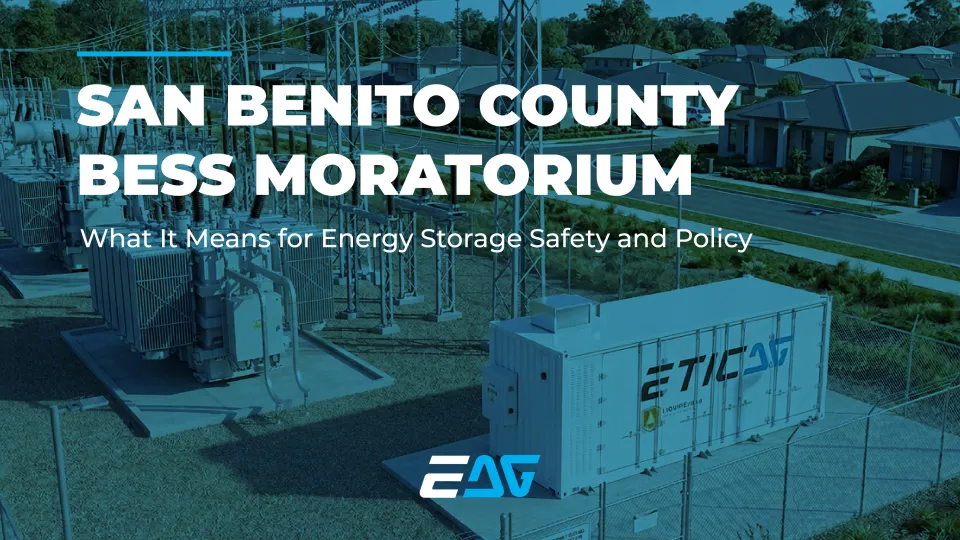
Introduction: A Temporary Pause with Long-Term Implications
San Benito County paused new battery energy storage projects after safety concerns and regulatory gaps made it clear existing standards are not sufficient. The County enacted a temporary moratorium to develop safety standards, environmental protections, and clear requirements for how battery storage projects are reviewed and approved before allowing additional projects to move forward.
This decision reflects a broader shift happening across the energy industry. As battery storage moves closer to communities, local governments are focusing on how systems manage heat at the cell level, prevent ignition, and control gas release during failure events.
These questions are now shaping whether projects are approved, delayed, or stopped entirely.
San Benito County is one example of a growing trend. Communities are not rejecting energy storage. They are requiring systems to meet clearly defined safety and performance standards before deployment.
San Benito County’s Moratorium and Ongoing Policy Review
The Moratorium and Why the County Acted
San Benito County approved a temporary pause on new large-scale battery energy storage system projects in March 2026 as officials evaluate how these systems should be regulated. The moratorium, expected to last approximately 40 to 45 days, suspends new permits and approvals while the County develops clear standards for future projects.
This action followed increased interest from developers in a region that did not yet have a defined framework for evaluating battery storage. Rather than moving forward under incomplete guidance, the County chose to pause and establish requirements first.
At the time of the moratorium, San Benito County did not have a dedicated ordinance governing battery energy storage systems (BESS). Projects were being considered without clear, BESS-specific standards.
Officials identified several critical gaps:
- No defined siting or land-use standards
- Limited safety requirements specific to large-scale battery systems
- No established emergency response framework
Recent battery fire incidents in California have increased urgency. Events such as Moss Landing raised concerns about battery safety and influenced the County’s decision to pause new projects.
The County’s response reflects a shift toward defining requirements before deployment, rather than adapting policy after projects are already in place.
What the County Is Evaluating During the Moratorium
During the moratorium period, San Benito County is developing a framework that defines how battery storage projects will be evaluated and approved moving forward. A draft ordinance is expected within the following 60 days, with the possibility of extending the moratorium if additional review is needed.
This includes:
- Land-use and siting compatibility
- Setback distances from homes and critical infrastructure
- Fire safety standards and emergency response planning
- Environmental protection measures
These factors directly influence where projects can be built, how they are designed, and whether they can move forward through the approval process.
Public input is playing a central role in shaping the County’s approach. Residents, planners, and emergency responders are actively participating in discussions about safety, siting, and environmental impact.
These conversations focus on how battery systems behave during failure scenarios and what protections must be in place before deployment.
Why Safety Concerns Are Driving Policy Decisions
Fire Risk and Thermal Runaway
Fire risk is the primary factor driving San Benito County’s decision to pause battery energy storage projects. Lithium-ion systems behave differently under failure conditions than traditional infrastructure, which has increased scrutiny at the local level.
Lithium-ion batteries store large amounts of energy in compact cells. When a failure occurs, that energy can be released rapidly through thermal runaway.
The central concern is propagation. Heat from one cell can transfer to adjacent cells, escalating the event across the system. This behavior has shifted how local governments evaluate risk, focusing on whether failures remain contained or spread beyond a single cell.
Air Quality and Gas Exposure
Battery failures can produce hazardous gases such as carbon monoxide and hydrogen fluoride. These emissions are a key concern in public discussions surrounding energy storage projects.
In San Benito County, environmental and safety considerations include how these gases are managed during a failure event and whether they can impact surrounding communities.
These factors influence how projects are evaluated and what safety measures must be demonstrated before approval.
Emergency Response Considerations
Battery-related incidents require different response strategies than traditional fires. They can involve extended monitoring, controlled mitigation, and coordination between multiple agencies.
As part of the moratorium, San Benito County is evaluating what level of preparedness is required before systems are deployed. This includes how emergency responders interact with battery systems and what planning must be in place prior to operation.
This is changing how safety is evaluated. System design and performance now determine how risks are addressed before deployment.
Broader Siting and Environmental Considerations
In addition to fire and safety risks, local reviews of battery storage projects typically include land-use compatibility and environmental impact.
In San Benito County, these considerations are part of the broader effort to define how projects should be evaluated before approval. This includes where systems are located, how they interact with surrounding land uses, and how potential impacts are managed.
These factors shape setbacks, project feasibility, and overall community acceptance.
Why Energy Storage Still Matters for San Benito
Despite increased scrutiny, the role of BESS in modern power systems continues to expand. Local governments are focused on how energy storage can be deployed safely within existing communities.
Grid Reliability
Battery storage supports grid stability during periods of high demand. As electricity consumption increases, particularly in regions with growing electrification, stored energy can be deployed to maintain system balance.
This reduces strain on infrastructure and helps prevent outages during peak conditions.
Electricity Cost Stability
Energy storage allows electricity to be stored when demand is lower and dispatched during peak periods. This reduces reliance on higher-cost generation resources that are typically used to meet short-term demand spikes.
By lowering peak demand, storage contributes to more stable electricity pricing and reduces the need for large-scale infrastructure expansion.
Emergency Resilience
Battery systems provide backup power during grid disruptions. This capability is critical for infrastructure that must remain operational during outages, including hospitals, water systems, and communication networks.
As extreme weather events and grid disruptions become more frequent, the ability to maintain power continuity is becoming a central consideration in energy planning.
How EticaAG Enables Safe Deployment of Energy Storage
As regulatory expectations shift toward prevention-based safety, system design determines whether battery energy storage projects can meet approval requirements.
Most conventional systems are designed to manage temperature during normal operation, but they often rely on containment and suppression strategies once a failure begins. The concerns driving San Benito County’s moratorium, including fire risk, gas exposure, and emergency response complexity, are directly tied to how systems behave under failure conditions.
EticaAG’s battery energy storage systems are engineered to address these risks at the source, aligning system performance with the safety criteria now shaping local policy decisions.
LiquidShield Immersion Cooling
LiquidShield immersion cooling submerges each battery cell in a non-toxic dielectric fluid that continuously transfers heat away from the cells. This maintains stable operating temperatures and prevents the conditions that lead to thermal runaway.
The fluid also isolates each cell from oxygen. In the event of an internal failure, the liquid barrier immediately suppresses flames and prevents ignition. Fire propagation does not occur because combustion conditions are eliminated at the cell level.
HazGuard Gas Neutralization Technology
Battery failure scenarios can produce hazardous gases that present risks to both nearby communities and emergency responders. HazGuard toxic gas neutralization technology manages these gases within a sealed system.
Gases are captured, directed through controlled pathways, and neutralized before release. The air leaving the system is inert, preventing environmental exposure and supporting safer emergency response.
Integrated Safety Architecture
Together, these technologies:
- Control heat at the source
- Prevent ignition
- Neutralize hazardous gases
This integrated approach aligns directly with how jurisdictions are evaluating battery storage projects. By eliminating fire propagation and controlling environmental risk, system design supports safer deployment and more predictable approval outcomes.
Conclusion: What This Means for Energy Storage Deployment
San Benito County’s decision to implement a temporary moratorium reflects a broader shift in how battery energy storage systems are evaluated and approved. Safety is becoming a primary factor in permitting, with projects expected to demonstrate how risks are addressed before deployment.
This is influencing both system design and the approval process. Performance under failure conditions is now a key consideration alongside normal operation.
At the same time, the need for energy storage continues to grow, driven by increasing demand for grid reliability, cost stability, and resilience.
As San Benito County works to define its framework, it reflects a wider trend across jurisdictions. Regulatory expectations are evolving, and these changes will shape how energy storage is deployed and where projects are able to move forward.


